
Tips · Winter
'Ski-in ski-out': what it really means
'Ski-in ski-out', 'at the foot of the slopes', 'ski to the door'… The phrase sells a dream, but it covers wildly different realities. Here's what it actually means, and how to check before you book.
10 July 2026 · 10 min
‘Ski-in ski-out chalet’, ‘apartment at the foot of the slopes’, ‘ski to the door residence’… On rental sites the phrase is everywhere, and it works: who hasn’t dreamed of clipping into their skis on the doorstep and gliding home again, skis still on? The trouble is that the term is governed by no standard whatsoever. Between a genuine piste-side door and the ‘few hundred metres on foot’ of an optimistic listing, the gap can be enormous — and it turns into a daily chore when you’re carrying the children’s skis through fresh snow. Here in Oz-en-Oisans we’ve chosen transparency: here’s what ‘ski-in ski-out’ really means, and above all how to check it before you book.
Where the phrase comes from
‘Ski-in ski-out’ means, literally, ‘you enter on skis, you leave on skis’. The idea is simple and seductive: from your accommodation you reach the ski area with your skis on, and you come back the same way at the end of the day — no shuttle, no car, no carrying your gear over hundreds of metres. The French say ski aux pieds, ‘skis on the feet’, or au pied des pistes, ‘at the foot of the slopes’.
In its purest sense, ski-in ski-out describes a building that a piste or lift touches directly: you open the door, clip your boots into the bindings, and glide. It’s the ultimate ski-holiday fantasy, and a powerful sales argument. But in reality that ideal is rare, expensive and usually high up the mountain, away from the village and its shops.
The catch is that nothing stops a listing from using the very same phrase for somewhere far more distant. No label, no authority polices the term. As a result, ‘ski-in ski-out’ can describe a chalet a run grazes past the terrace just as easily as an apartment from which you must walk, climb a staircase, cross a residence and cover 300 metres before you reach the first magic carpet. Both are ‘ski-in ski-out’ on paper. On the ground, they have nothing in common.
The three realities the phrase hides
To see clearly, you need to separate the situations the phrase conceals. Here are the three most common cases.
- The genuine piste-side departure (strict 'ski-in ski-out'). A run passes right by the building, or a lift starts less than 20 metres away. You clip in at the door and return skis-on in the evening. It's the ideal — and the rarest, priciest option.
- Immediate proximity ('at the foot of the slopes'). The property is a few dozen metres from a lift or piste: 30, 50, sometimes 100 flat metres. You walk one or two minutes with skis in hand, then everything is done on skis. It's the best comfort-to-price compromise, very common in village-resorts.
- Relative proximity ('close to the slopes'). Several hundred metres, a slope to climb back up in the evening, sometimes a free shuttle. Still handy, but it isn't ski-in ski-out: always ask for the exact distance.
The difference between these three cases decides your daily comfort. With young children, gear to carry and a full week ahead, the gap between 50 flat metres and 350 metres with a bank to climb is not trivial: it’s repeated four to six times a day, in ski boots.
The classic trap
Beware the 'ski-in ski-out' that only works one way. Many properties let you set off on skis (you ski a run down from the residence) but not return that way: in the evening no piste brings you back to the door, and you finish on foot, walking uphill with skis over your shoulder. Always ask about the return: 'In the evening, does a piste bring me back skis-on all the way to the accommodation?'
How to check before booking: the 3 numbers to ask for
Don’t rely on the words ‘ski-in ski-out’ in the listing’s title alone. Before you book, ask the owner — or check yourself — three precise numbers. An honest host will give them to you without hesitation; a dream-seller will stay vague.
- The walking distance to the first lift or piste, in metres (not in 'a few minutes', which means nothing).
- The gradient and nature of the walk: flat, downhill, or is there a bank to climb in the evening? Do you cross a road?
- The skis-on return: does a piste bring you back to the accommodation at the end of the day, or do you finish on foot?
With those three answers in hand, cross-check them against two free tools. First the resort’s official piste map, which shows where the runs pass and where the lifts start relative to the buildings. Then a satellite view (any mapping service): measure the distance yourself between the accommodation and the nearest lift. In two minutes you’ll know whether the listing’s ‘ski-in ski-out’ holds up.
The owners' tip
When a listing stays vague about the distance, it's never by accident. We'd rather give you the exact figure: about 50 flat metres between the chalet and the ski lift, in a fully pedestrian village. Ask directly — 'how many metres, uphill or flat, and do I get back skis-on?' — and trust the precision of the answer as much as the figure itself. An owner who knows their ground replies in three seconds.
— Célia, Isabelle, Olivier & Wilfrid
Our stance: transparency over fantasy
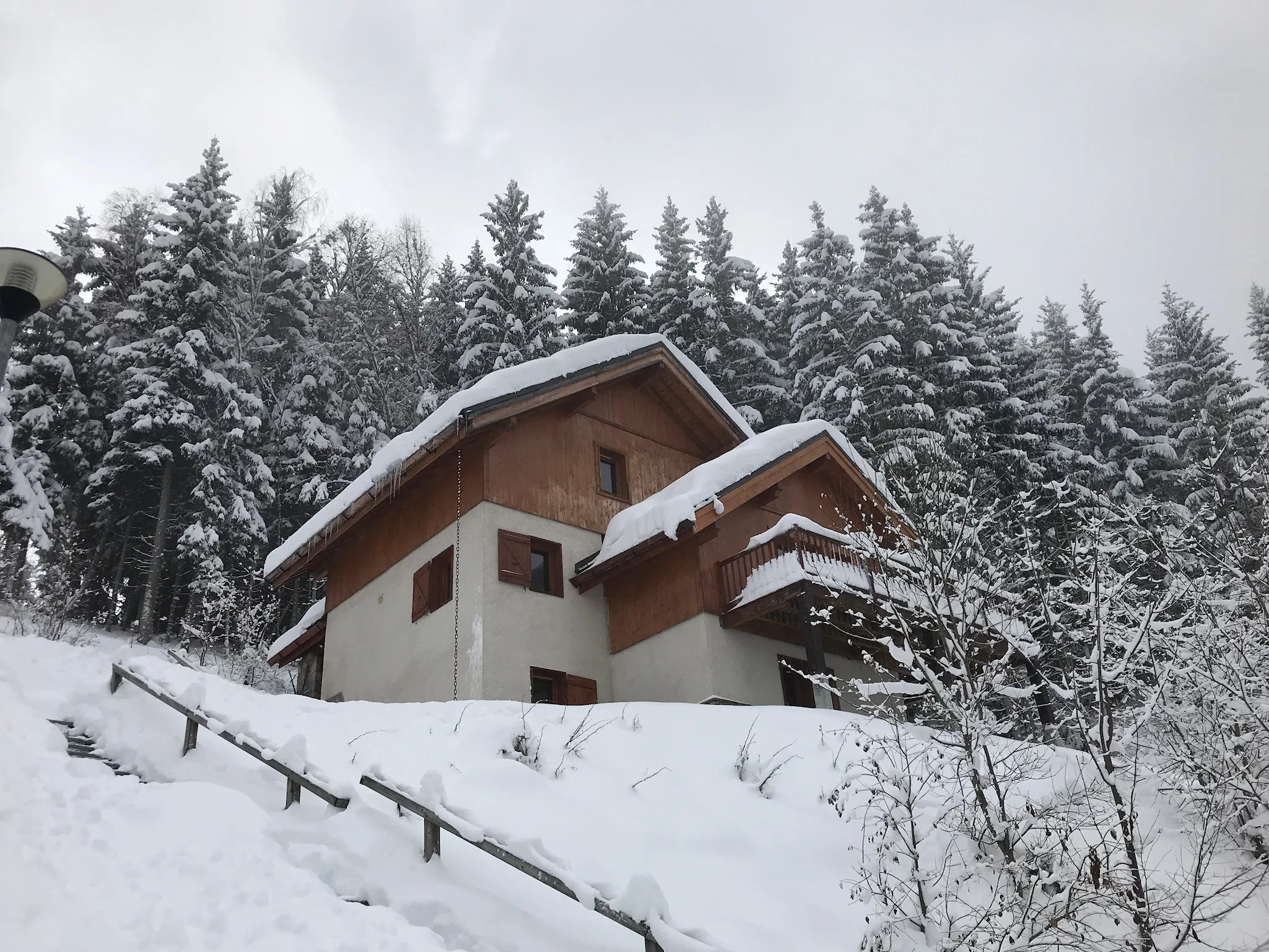
Let’s be clear: the Ozalp’ Cottage chalet does not have a piste running past the door. We could have written ‘ski-in ski-out’ in big letters at the top of the listing, like many do — the phrase isn’t protected, no one would have stopped us. We chose not to, because you wouldn’t enjoy discovering the truth on arrival, suitcases in hand, on a snowy Saturday.
Here’s the reality: the chalet sits about 50 metres from a ski lift, in the village-resort of Oz-en-Oisans. That lift serves the snow front and its beginners’ area; from there, the whole Alpe d’Huez Grand Domaine opens up via the connecting lifts. Fifty metres is a two-minute flat walk, with no road to cross, in a village where everything is pedestrian. For the vast majority of our guests, that’s more than enough — and often more practical than an isolated piste-side departure.
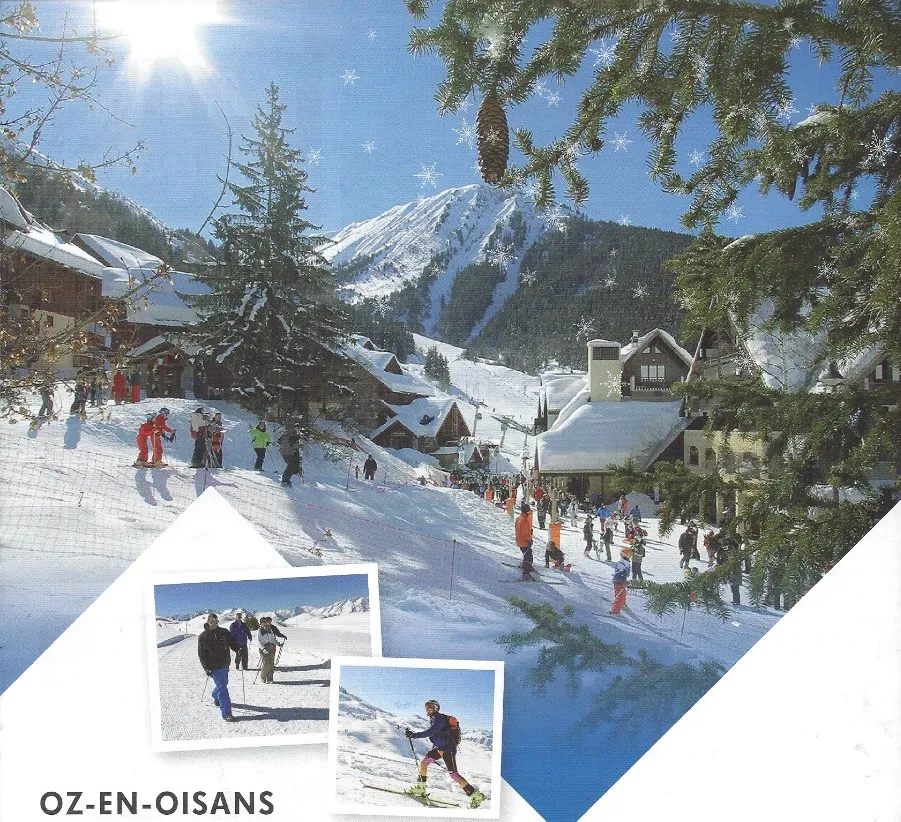
Why? Because Oz is designed as a compact village: the shops, the ski school, ski hire, the restaurants and the lifts are all clustered a few minutes’ walk from one another. You clip in near the chalet, ski all day, come home for a warm lunch if you fancy it, and head back out in the afternoon. No shuttle to wait for, no car to bring back out. It’s the real comfort of a mountain holiday, without the price or the isolation of the picture-postcard ‘ski to the door’.
Good to know
In Oz-en-Oisans, the snow front gathers a beginners' area, magic carpets, a ski school (ESF) and a sledging zone, all a few minutes from the chalet in a pedestrian setting. Two green runs start directly from the resort: genuine beginners and children have space to progress without ever taking the car or crossing a busy road. It's one of the quiet but decisive advantages of a human-scale village-resort.
Ski-in ski-out or village-resort: which model for a big group?
When you’re booking for 16 people — a family reunion, a group of friends, two or three families together — the ski-in ski-out question plays out differently than for a couple. A genuine piste-side departure, high on the mountain, comes at a cost: it’s pricier, further from services, and you often have to drive back down for groceries or a pharmacy. Multiplied by 16, every shuttle or car trip becomes a logistical exercise.
By contrast, a chalet in the heart of a pedestrian village-resort offers a balance that’s hard to beat for a group: everyone reaches the slopes on foot at their own pace, beginners stay near the ski school, confident skiers head off into the Grand Domaine, and everyone meets back at the chalet for lunch or an afternoon snack. Children reach the lift independently; non-skiing grandparents stay in the village without being stranded. This is exactly what we detail in our guide to organising a group ski trip: for 16, the resort’s fluidity often matters more than the twenty metres between a door and a piste.
Add the Eau d’Olle Express gondola that links Allemond to Oz in 8 minutes, and you get a resort where you can leave the car at the bottom all week. For a big group, that logistical simplicity is worth its weight in gold — and it has nothing to do with whether or not a piste runs past the door.
Reading a ‘ski-in ski-out’ listing without being caught out: the method
Let’s summarise a simple method, valid for any rental, ours or anyone else’s. It will save you plenty of disappointment.
- Ignore the title, read the detail. 'Ski-in ski-out' in the title means nothing until the exact distance is written in black and white in the body of the listing.
- Demand the three numbers. Walking distance, gradient/nature of the walk, skis-on return in the evening. In metres, not impressions.
- Check the piste map. Locate the nearest lift and the return runs on the resort's official map.
- Measure on a satellite view. The real distance between the accommodation and the lift takes seconds to measure, without depending on the listing's vocabulary.
- Judge the quality of the answer. A host who replies quickly and precisely knows their ground. Artful vagueness is a warning sign.
Apply these five reflexes and you’ll never again be surprised by a ‘ski-in ski-out’ that isn’t one. You’ll know exactly what you’re booking: a genuine piste-side departure, immediate proximity of a few dozen metres, or a more serious distance to plan for. None of these three options is bad in itself — what matters is to choose with your eyes open, according to your group, your children and your budget.
★★★★★
"We were afraid we'd have to carry the children's gear every morning. In fact the ski lift is a two-minute walk from the chalet, everything is pedestrian, and the little ones went there almost on their own. Far more practical than we imagined."
The takeaway
‘Ski-in ski-out’ is a lovely promise — but it’s a promise without a standard. Behind the phrase hide realities that range from a piste-side door to a few hundred metres to cover every day. The only way not to be fooled is to ask for the numbers and check for yourself on a piste map and a satellite view. Three questions are enough: how many metres, with what gradient, and do you return skis-on in the evening?
Our answer is simple and owned: the chalet isn’t glued to a piste, but it’s about 50 metres from a ski lift, in a 100% pedestrian village-resort where you ski, you live and you leave the car in the garage. For a big group, that compromise often beats the picture-postcard ‘ski to the door’. And above all, you know in advance exactly what you’re booking — that’s how we do things.
Planning a ski trip for 16? Discover the Ozalp’ Cottage chalet, read our guide to renting a chalet for 16 people in the Alps, check our rates and availability, and write to us via the contact form: we’ll call you back to explain everything, distances included. For the resort’s official information, the snow front and beginners’ area page and the Oz-en-Oisans piste map are the reference.
Frequently asked questions
What does 'ski-in ski-out' actually mean?
Is 'ski-in ski-out' the same as 'at the foot of the slopes'?
Does 'ski-in ski-out' mean the piste arrives at the door?
How do I check that a chalet is genuinely at the foot of the slopes?
Is it a problem if a chalet is 50 metres from a lift rather than piste-side?
Is the Ozalp' Cottage chalet in Oz-en-Oisans 'ski-in ski-out'?
What's the difference between 'at the foot of the slopes' and 'close to the slopes'?
Can a family ski from a chalet that isn't piste-side?
Do you need a car to ski in Oz-en-Oisans from the chalet?
Does 'ski-in ski-out' cost more?
Read next
TipsSkiing in January off-peak: the smart move for groups
Empty slopes, prices cut almost in half and a wide-open chalet: why January outside the school holidays is the best ski week of the winter for a large group free to choose its dates.
Read more Tips
TipsSkiing during the 2030 Olympics: pick a quiet resort
In February 2030, while the host resorts of the Games are overrun, Alpe d'Huez will be running at full tilt with no events at all. The smart play: ski in peace and pop over to watch a competition for the day.
Read more Guide
GuideFebruary half-term in Alpe d'Huez: book early
French zone dates, peak-season prices, crowds and clever tips to ski smart: the complete guide to the February half-term at Alpe d'Huez, seen from the chalet in Oz.
Read more